
Paralives is currently redefining the creative boundaries of the life simulation genre by introducing a level of architectural autonomy that players have craved for nearly two decades. While the genre has traditionally been defined by rigid grid systems and limited object manipulation, this new contender is proving that the future of digital home-building lies in total player agency. By dismantling the technical barriers between a player’s vision and the game’s engine, the developers are fostering a sense of wonder that has been absent from the market for quite some time.

▲ Official Cover Art (Source: IGDB)
| Feature | Details |
|---|---|
| Developer | Paralives Studio |
| Current Status | Early Access (Active Development) |
| Core Innovation | Grid-free construction and parametric furniture scaling |
| Platform | PC / Mac |
Background: The Evolution of the Life Sim Architect
For many veteran players, the transition from being a simple character creator to a dedicated digital architect is a natural progression. The early days of the genre focused heavily on social interactions and personality sliders, but the meta-game has shifted significantly toward complex environmental design. Players are no longer satisfied with pre-built boxes; they demand the ability to craft cluttered, lived-in spaces that reflect a realistic sense of domesticity. Paralives addresses this shift by providing tools that feel like professional design software disguised as an intuitive gaming experience.
The development team, comprised of enthusiasts who grew up with the genre, has clearly identified the pain points that have plagued simulation fans for years. Instead of relying on a massive library of static assets, the focus has shifted toward malleable objects. This approach allows a relatively small team to deliver a creative suite that feels more expansive than those found in high-budget alternatives. It is a testament to the power of focusing on user experience and mechanical depth over sheer asset volume.
Structural Comparison: Paralives vs. The Traditional Grid
The most immediate and impactful change in Paralives is the removal of the traditional grid system. In most simulation titles, players are restricted by invisible floor tiles that dictate where walls can be placed and how furniture is oriented. By allowing walls to be drawn at any length and any angle, the game opens the door for complex floor plans, such as star-shaped houses or realistic curved corridors. This freedom ensures that no two builds are ever truly identical, encouraging a high level of community experimentation.
Beyond the floor plan, the verticality and depth of objects are also fully under the player’s control. You can stretch windows to cover entire walls, adjust the drop of curtains to match specific window heights, and even scale decorative clutter to fit perfectly on a crowded kitchen counter. This parametric design philosophy means that a single sofa model can be transformed from a compact two-seater into a massive sectional for a growing family, effectively multiplying the utility of every item in the game.
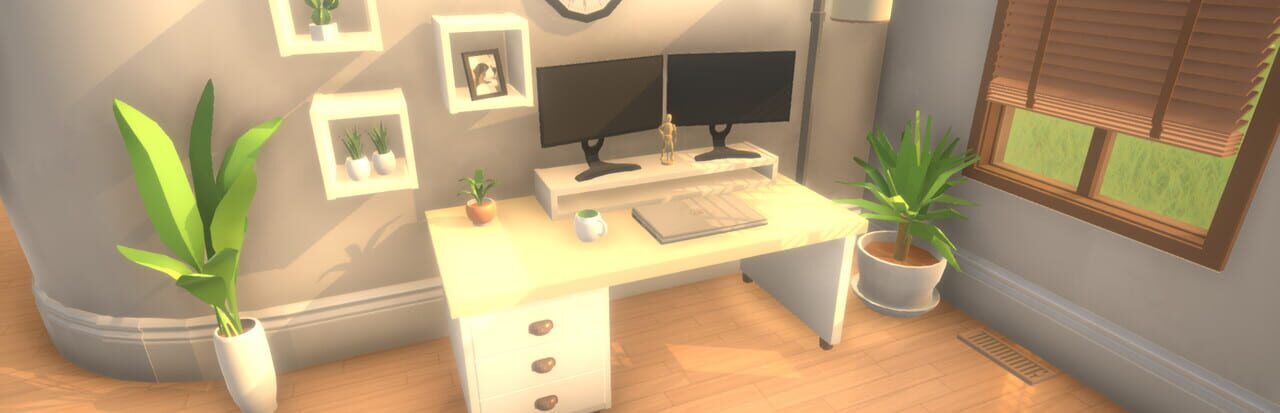
▲ Official Artwork (Source: IGDB)
The Return of Infinite Customization
One of the most celebrated features making its return in this new era is the deep color and texture customization system. Similar to the beloved mechanics found in the third iteration of the genre’s biggest competitor, Paralives offers a color wheel and diverse texture options for nearly every surface. A simple full-length mirror can be transformed from a plastic, vibrant accessory into a sophisticated brass fixture with just a few clicks. This level of granular control ensures that players are never limited by the default swatches provided by the developers.
Cultural and UX Value Analysis: Empowering the Player
The cultural impact of Paralives stems from its status as a project built for the community, by the community. The developers are simmers-turned-creators who understand the “sicko level” of detail required to satisfy hardcore builders. By allowing unfettered access to surfaces for cluttering and providing tools that mimic real-life architectural freedom, the game fosters a deep emotional connection between the player and their digital creations. It is a form of wish fulfillment for those who dream of interior design but lack the real-world tools to pursue it.
Despite being in an early access state with its share of bugs and game-breaking glitches, the core foundation is incredibly promising. The influx of custom content from the community is already beginning to trickle in, further expanding the possibilities of what can be achieved. As the game continues to evolve, the synergy between official updates and community creativity will likely cement its place as a staple of the genre. The sense of awe that comes from realizing you can simply “make it fit” instead of deleting an item is a powerful psychological hook that keeps players coming back for more.
[Paralives proves that intuitive mechanical depth outweighs raw asset quantity in creative sims]
By focusing on parametric scaling and grid-free movement, the developers have solved a decade-old frustration where players were fighting the engine rather than creating. This structural freedom allows for a level of emergent creativity that static libraries simply cannot match. The success of these tools in an early access environment suggests that the future of the genre will be defined by malleability and player-driven design rather than curated content drops.
Final Pulse Score: 8.8 / 10