
Rhythm Heaven Groove marks a sensational return for one of Nintendo’s most cherished yet underutilized franchises, delivering a masterclass in pure rhythm-based design. In an era where music games often overcomplicate their control schemes with plastic peripherals or overwhelming button layouts, this release strips away the unnecessary gameplay fluff to focus entirely on the core relationship between the player and the beat. It has been far too long since the franchise graced a dedicated home console, and this entry takes full advantage of modern hardware. The result is an incredibly addictive, sensory experience that reminds us why the simple act of keeping time can be so profoundly satisfying.
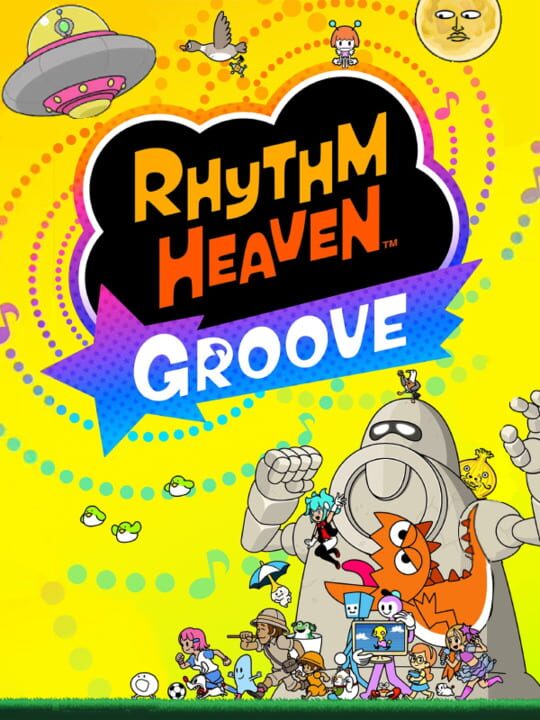
▲ Official Cover Art (Source: IGDB)
| Game Title | Rhythm Heaven Groove |
| Art Director | Ko Takeuchi |
| Lead Composer | Tsunku |
| Version Tested | Nintendo Switch 2 |
| Key Feature | Over 80 unique minigames |
| Core Controls | One to two buttons maximum |
The Brilliant Simplicity of Rhythm Heaven Groove
Unlike traditional rhythm titles that demand complex finger gymnastics, the core gameplay of Rhythm Heaven Groove relies on an elegant control scheme that rarely asks for more than a single button press. This brilliant design philosophy shifts the challenge from physical dexterity to pure auditory focus, prompting players to close their eyes and rely entirely on audio cues to hit perfect beats. Across 16 packed stages, players encounter a whimsical array of challenges, from matching beats with synchronized dancers to dodging sudden lightning strikes, and communicating with quirky aliens. Each minigame is short enough to encourage continuous replays, but long enough that securing a Perfect accolade always feels earned. The game constantly bends its simple mechanics in surprisingly creative ways, ensuring that every microgame feels like a completely fresh challenge.
Mechanics Breakdown and Latency Optimization
To fully appreciate the design of Rhythm Heaven Groove, one must look at how the developers demand absolute precision rather than standard rhythmic leeway. Many modern music games offer generous input windows to compensate for modern television display lag, but this title demands strict accuracy, actively recommending handheld play on the Nintendo Switch 2 to minimize visual and audio latency. The transition between different time signatures, such as shifting from a standard 4/4 beat to a trickier 3/4 signature in the Beatspell campaign, provides a genuine educational crash course in musical structure. It teaches players how music is formed from the ground up, providing real value for amateur musicians and casual gamers alike. It is this mechanical depth, hidden beneath an incredibly charming aesthetic, that elevates the title beyond a simple casual distraction.

▲ Gameplay & Official Media (Source: IGDB)
A Sensory Masterpiece of Audio and Visual Chaos
The artistic synergy in Rhythm Heaven Groove created by art director Ko Takeuchi and composer Tsunku creates a delightfully chaotic sensory environment that actively tries to test your concentration. In stages like the A for Effort minigame, flashing stock images of beverages appear on screen to intentionally disrupt your visual tracking, forcing you to decouple what you see from what you hear. It is a brilliant execution of synesthesia, akin to what players experience in Tetris Effect, though here the music acts as the absolute guide rather than a byproduct of your actions. You do not need to stare at the screen because the audio tells you exactly when to press the button. Additionally, the inclusion of licensing from high-profile artists like Ado adds a modern, energetic flair to the stellar original soundtrack, making every stage an absolute joy to replay.
Evaluating the Pros and Cons of a Musical Paradise
The package of Rhythm Heaven Groove feels incredibly complete, bolstered by multiplayer rhythm games that are poised to replace traditional party games at social gatherings, alongside charming WarioWare-style microgames. The multiplayer component functions beautifully, offering synchronized rhythmic challenges that turn cooperative play into a hilarious test of collective timing. The only minor drawback is that the sheer demand for precision might create a steep barrier to entry for players lacking a natural sense of rhythm, as the game rarely pardons off-beat inputs. However, the short length of the individual minigames ensures that failure never feels punishing, instead motivating players to instantly jump back in for another attempt. Even the end credits sequence is structured as a playable bonus game, proving how much care went into maximizing the content.
Rhythm Heaven Groove proves that stripping away input complexity is the key to unlocking pure musical synesthesia.
By limiting the controls to just two buttons, the game forces players to engage with auditory cues on a level that complex rhythm games simply cannot match. It successfully bridges the gap between active gameplay and passive listening, creating an educational yet incredibly fun environment. The masterclass design by Tsunku and Ko Takeuchi elevates this from a simple minigame collection to an essential masterpiece of modern rhythm gaming design.
Final Pulse Score: 9.5 / 10
Related Article: Hatsune Miku Starry Party Announced For Switch 2 and PC