
NBA 2K27 serves as the official live debut for Nvidia DLSS 5 neural rendering, giving PC enthusiasts their first real-world look at the controversial AI visual overhaul. Following months of skepticism surrounding aggressive AI filters and altered character models, the actual in-game implementation inside Visual Concepts newest basketball simulation proves surprisingly grounded. Rather than transforming the court into an over-processed digital painting, the technology respects the underlying art direction while adding fine surface details, though it extracts a staggering performance toll from your graphics card.

▲ Official Cover Art (Source: IGDB)
| Hardware Configuration | DLSS 5 Target Resolution |
|---|---|
| GeForce RTX 5080 | 1440p Ultra Ray Tracing |
| GeForce RTX 5050 | 1080p Ultra Ray Tracing |
| Rendering Framework | 3D Guided Neural Rendering |
| Visual Focus | Selective Masked Fidelity |
| Framerate Impact | 54 Percent to 67 Percent Drop |
Visual Fidelity and Artistic Restraint on the Virtual Hardwood
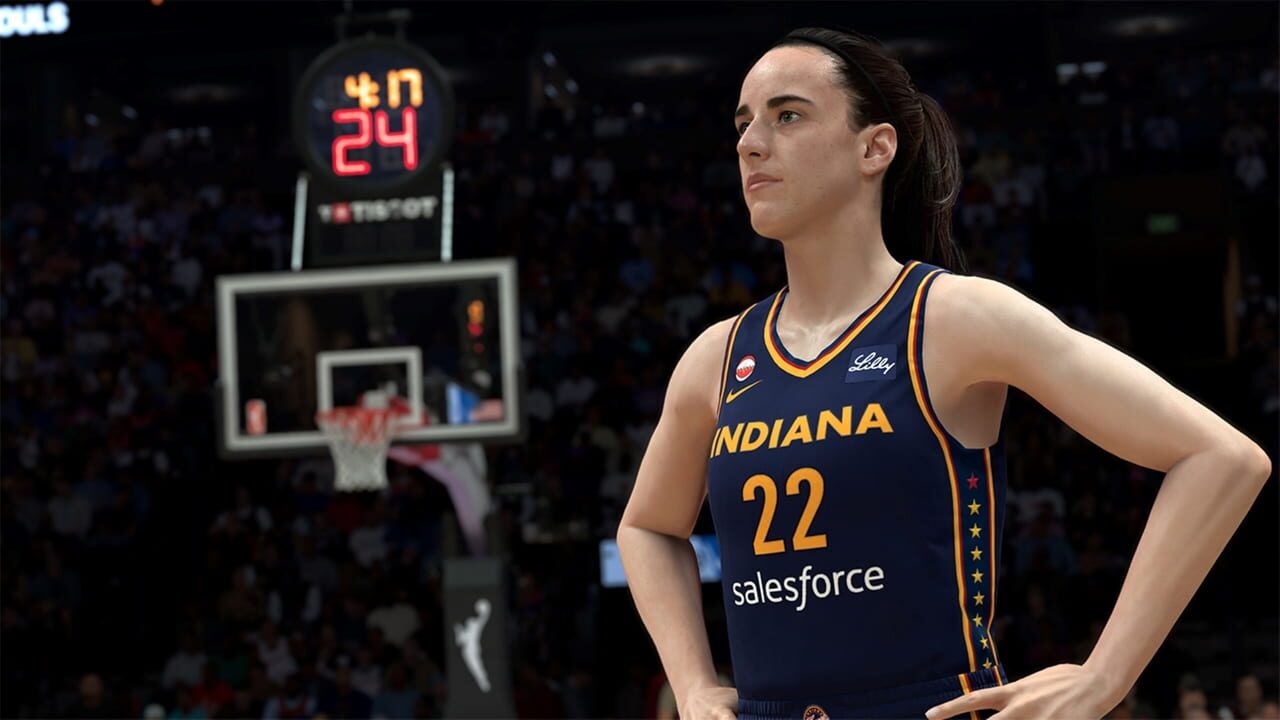
The primary fear surrounding neural rendering was the potential destruction of artistic intent, yet NBA 2K27 manages to avoid the dreaded plastic look. Because the sports sim already targets photorealism, subtle enhancements to player skin perspiration, jersey cloth weave, and varnished hardwood floors blend seamlessly into the presentation. The neural processing operates through selective developer masking rather than applying a blanket filter, ensuring player face geometry and skin complexions remain faithful without bizarre morphing or skin tone shifting.
Crucially, high-velocity elements on screen avoid the severe warping that plagued earlier technology demonstrations. Fast-moving basketballs retain their crisp spherical outline during rapid passing plays and transition dunks, resisting edge breakup under standard motion blur. Viewed from the standard broadcast camera perspective, the neural enhancement integrates naturally, elevating background crowd realism and sideline coaching staff without betraying the core aesthetic of NBA 2K27.
The Heavy Hardware Cost of DLSS 5 in NBA 2K27
While the visual upgrade avoids artistic disaster, the hardware penalty is severe enough to challenge modern GPUs. Testing the implementation on an RTX 5080 at 1440p with maxed ray tracing reveals an immediate 54 percent drop in framerate, plunging from an ultra-smooth 211fps down to 98fps. The burden becomes far harsher on entry-tier silicon, where an RTX 5050 running at 1080p drops from 137fps to an unplayable 44fps upon toggling the neural pipeline on, demanding a 67 percent performance sacrifice for subtle fidelity gains.
Attempting to offset this massive frame deficit using DLSS 4 Multi-Frame Generation introduces substantial visual compromises. Engaging 3x Multi-Frame Generation restores framerates to 99fps on lower-tier hardware but produces visible artifacting, including warping on player identification tags and disintegrating hand textures during fast ball releases. Pushing to 6x mode exacerbates ghosting along high-contrast jersey edges and increases input latency, directly undermining the tight timing required for precision jump shots and defensive steals in NBA 2K27.
▲ Gameplay & Official Media (Source: IGDB)
Long-Term Outlook for Neural Rendering and Platform Support
At present, DLSS 5 remains restricted to the latest RTX 50 series architecture, operating essentially like a heavy machine-learning layer on top of ray tracing. Ongoing driver refinements promise to optimize neural execution passes before expanding support outward to RTX 40 series cards. However, until developers find lighter execution models, pure neural upscaling functions best as an enthusiast showcase rather than an essential gameplay feature.
Future titles featuring stylized aesthetics will provide a truer test of whether this neural tech can adapt without creating visual homogenization across different game engines. For now, NBA 2K27 establishes a stable foundation that preserves fidelity at the expense of massive GPU overhead, proving that AI rendering can respect artist vision when implemented with developer restraint.
Subtle visual enhancements in NBA 2K27 cannot yet justify the steep performance tax.
DLSS 5 successfully avoids destructive aesthetic filtering on photorealistic character models, proving its viability for authentic sports titles. However, the catastrophic framerate reduction transforms modern graphics cards into struggling hardware, making Multi-Frame Generation an imperfect band-aid riddled with input latency. Until driver optimization matures, neural rendering remains a luxury toggle for ultra-high-end rigs.
Final Pulse Score: 7.0 / 10