
Constructing a sprawling industrial society is a familiar fantasy across the city-building genre, but building one upon the craggy, organic back of an astral cetacean transforms familiar management systems into a delicate ecological tightrope. Beyond These Stars places players in stewardship of Kewa, a colossal space whale traversing the cosmos, forcing a continuous reconciliation between urban ambition and biological preservation. Rather than carving out lifeless plots of dirt, every factory placement and road expansion directly affects the health, breathing atmosphere, and emotional state of your living foundation.

▲ Official Cover Art (Source: IGDB)
Symbiosis Versus Industrial Exploitation
The core gameplay loop of Beyond These Stars diverges sharply from typical factory simulators by tying operational survival to ecological responsibility. Expanding production facilities such as smelters, copper foundries, and wood-fired generators generates severe local pollution that seeps directly into Kewa’s waterways and soil. Poisoned rivers run iridescent with toxic runoff, reducing agricultural yields and degrading the creature’s atmospheric bubble. Mitigating these disasters requires balancing automated cleaning infrastructure against tight resource margins, halting heavy steel output, and dedicating valuable tracts of land to rewilding efforts rather than immediate industrial gain.
This environmental tension ripples directly into citizen morale and Kewa’s physical wellbeing. When the leviathan suffers from unchecked industrial blight, thorny growths erupt across its back, lowering citizen happiness and destabilizing productivity. Conversely, cultivating lush forests and tending neglected extremities triggers vibrant floral blooms that raise general welfare. The push-and-pull between extracting vital resources for survival and preserving the biological integrity of the host organism introduces a welcome friction that prevents the experience from slipping into passive, low-stakes comfort.
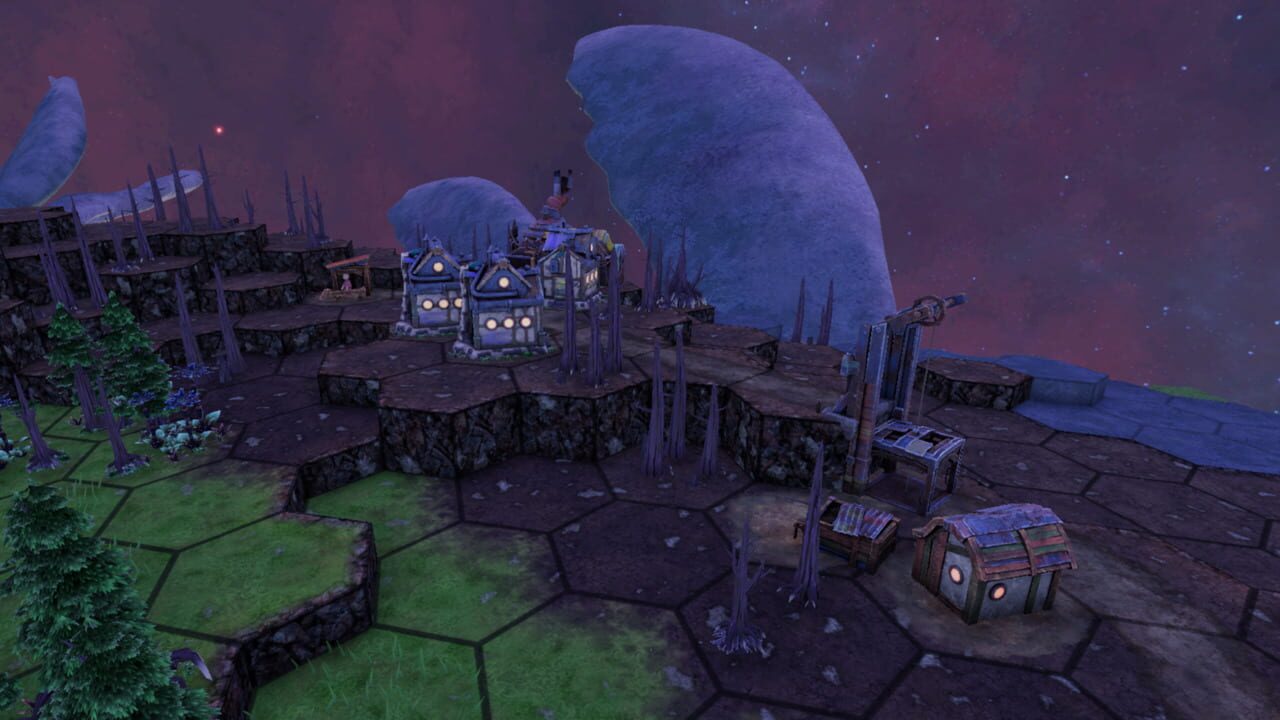
▲ Gameplay & Official Media (Source: IGDB)
Hexagonal Architecture and Logistics Friction
Managing logistics atop an irregular, curved organic surface introduces distinct spatial puzzle elements. Municipal development in Beyond These Stars relies on a hexagonal tile system where structures occupy between one and three hexes. Early-game logistics can feel demanding, as early electrical systems require strict physical clustering before long-range power distribution grids are researched. The building footprints do not always cleanly align with the underlying hex geometry, meaning players must carefully plot road connections to prevent inadvertent bottlenecks and isolated production facilities.
Supply chain diagnostics occasionally suffer from interface density. Unraveling production stalls demands close monitoring across layered operational overlays, as an idle manufacturing line is often the result of distant labour reallocation, such as furloughed lumber camps stalling wood-fired power plants. Fortunately, the title balances this logistical strictness with forgiving relocation mechanics, allowing players to reorganize layouts without devastating demolition penalties while adapting to shifting resource demands.
Organic Milestones and Cosmic Exploration
The progression structure avoids passive tech point accumulation, opting instead for milestone-driven research tied directly to active production feats. Forging target quantities of copper ingots or establishing specific agricultural nodes triggers tech tree advancements organically, anchoring societal development in tangible civic accomplishments. Outside of domestic whale maintenance, interstellar travel dictates broader pacing. As Kewa navigates through different solar systems, planetary expeditions offer opportunities to harvest exotic raw materials and uncover narrative fragments detailing the leviathan’s mysterious past.
- Pros: Innovative symbiotic city-building dynamic, milestone-driven technological progression, and distinct visual blend of rustic and futuristic architecture.
- Cons: Dense interface overlays make bottleneck diagnosis cumbersome, and irregular building footprints complicate hexagonal road layouts.
📌 Frequently Asked Questions (FAQ)
Q. What is the primary setting and premise of Beyond These Stars?
A. The game tasks players with building and managing a thriving civilization across the back of Kewa, a colossal space-faring whale traveling across the galaxy.
Q. How does pollution affect gameplay in Beyond These Stars?
A. Industrial runoff poisons local rivers and soil, degrading the breathable atmospheric dome and hurting Kewa, which sprouts hazardous thorns and reduces citizen morale.
Q. How does technological progression work in the game?
A. Rather than generating abstract research points, technology unlocks are tied to tangible in-game accomplishments, such as smelting a set amount of metal bars or setting up specific facilities.
The Delicate Line Between Stewardship and Sabotage
By anchoring survival mechanics directly to the emotional and physical state of a living world, the title reframes city-building logistics around restraint rather than unchecked extraction. The inclusion of granular sandbox parameters allows players to tailor environmental pressures, revealing an intriguing systemic resilience when pushed toward ecological catastrophe. Balancing industrial efficiency against host survival delivers a refreshing mechanical friction rarely explored in traditional metropolis simulators.
Final Pulse Score: ⭐⭐⭐⭐☆
Related Article: Afterworld Paradox Bronze Age Collapse Analysis