
With the countdown to launch entering its final hours, Rockstar Games has delivered an unexpected yet fitting look at the atmospheric complexity powering its sprawling state of Leonida. In an authentic promotional crossover, a comprehensive meteorological breakdown was shared in tandem with The Weather Channel, detailing the microclimates, pressure shifts, and localized storm fronts players will navigate. Rather than treating atmospheric conditions as a passive skybox shader, the newly detailed system shows how meteorological unpredictability serves as a core pillar of open-world simulation.

▲ Official Cover Art (Source: IGDB)
Reimagining Open-World Meteorology in Leonida
Virtual worlds have traditionally relied on synchronized weather scripts, where an entire island or continent shifts from clear daylight to torrential downpour uniformly. Rockstar Games has upended that paradigm for GTA 6, building an engine capable of handling discrete, localized atmospheric patterns. According to Owen Shepherd, Vice President of Art: Light and Rendering at the studio, the engineering team completely redesigned the rendering architecture to support localized, persistent, and dynamically evolving weather patterns that mimic real-world subtropical environments.
Leonida draws direct architectural and geographical cues from modern-day Florida, a region famous for abrupt clashes between high humidity and coastal wind shears. The underlying light and volumetric systems now simulate towering cumulonimbus clouds that build density realistically over wetlands while leaving adjacent beachfront corridors bathed in blistering sunlight. This structural autonomy ensures that atmospheric events do not simply snap into place; they generate organically across pressure gradients, radically altering visibility and sound propagation across distinct sectors of the map.
Dissecting Regional Forecasts Across the Map
The presentation showcased six distinct geographical zones across Leonida, treated with the gravity of genuine meteorological alerts. Each report contextualized how specific topography triggers unique environmental hazards:
- The Keys and Key Lento: Commuter corridors subject to torrential rains and punishing ocean winds that drastically reduce highway visibility.
- Pelican Valley Swamps: Severe electrical thunderstorms that plunge the marshlands into pitch-black shadow, masking lurking wildlife beneath rolling surface mist.
- South Ocean Beach: Heavy sea fog capable of swallowing luxury beachfront properties, blinding coastal transit and dulling neon skylines.
- The Rusty Anchor Waters: Violent tropical disturbances triggering choppy swells, making open-water maritime travel hazardous for smaller watercraft.
- Gambit Bay: Low-lying morning mist settling over forest ridges just ahead of local hunting seasons.
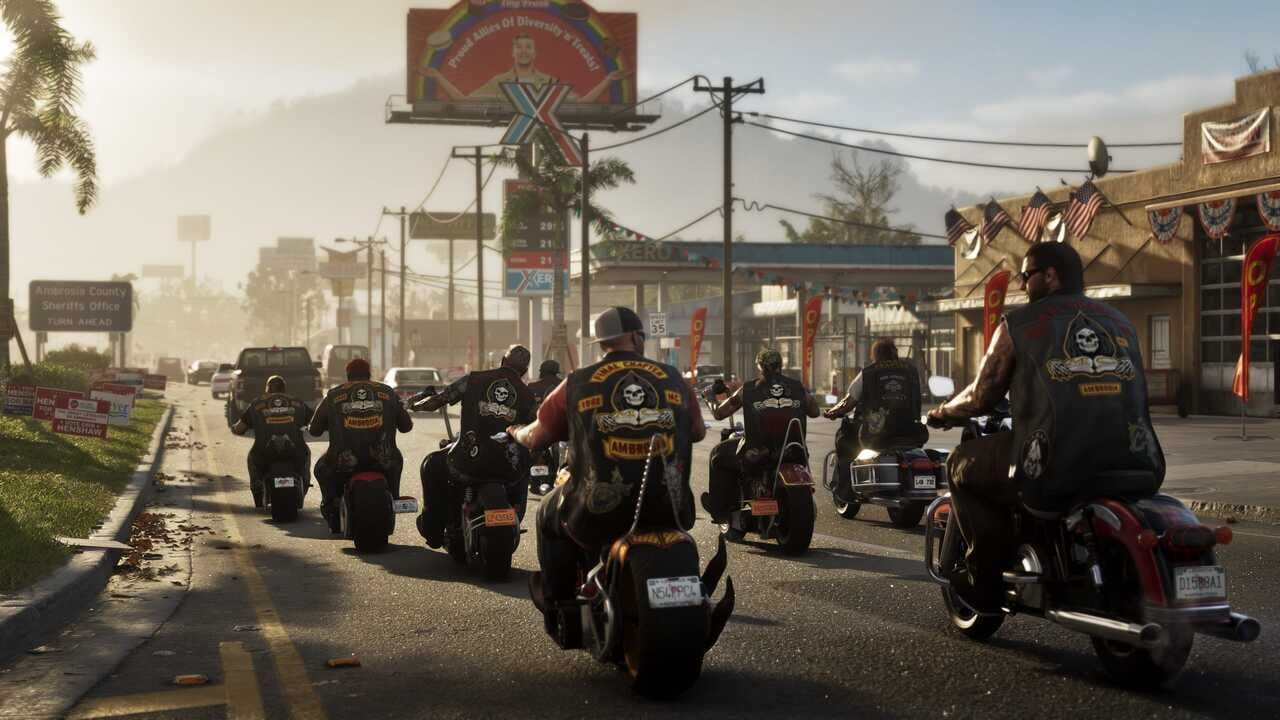
▲ Gameplay & Official Media (Source: IGDB)
Gameplay Consequences of Persistent Atmospheric Shifts
While visual spectacle is an immediate highlight, the gameplay implications of this level of weather simulation will fundamentally dictate player strategy during high-stakes missions. In previous entries, rain was predominantly a surface-friction modifier for vehicular handling. In GTA 6, the introduction of dense sea fog and sudden tropical fronts introduces tactical depth for both criminal heists and law evasion. A dense fog bank rolling over South Ocean Beach could provide immediate cover during a helicopter escape, while simultaneously rendering high-speed sea navigation lethal.
Maritime physics have clearly been tuned alongside weather generation. With tropical depressions churning the waters around spots like the Rusty Anchor, boat handling and deep-sea exploration will demand acute situational awareness rather than full-throttle cruising. If localized storms carry over into long pursuits, players traveling between Key Lento and the mainland will experience hydroplaning, crosswinds, and reduced braking distances, making routine getaways substantially more volatile.
| Target Setting | State of Leonida |
| Atmospheric Tech | Dynamic, Persistent Volumetric Clouds |
| Confirmed Hazards | Sea Fog, Tropical Storms, Cloudbursts |
| Target Platforms | PlayStation 5, Xbox Series X/S |
| Official Launch | November 19, 2026 |
The Final Stretch to November 19
The decision to market GTA 6 through authentic weather forecasts demonstrates Rockstar Games confidence in its world-building fidelity. The studio understands that immersion does not stem merely from map scale, but from the organic friction between the player and their environment. As enthusiasts prepare for the global launch on November 19, 2026, the prospect of managing sudden squalls across the Keys or evading tactical units amidst a blinding swamp thunderstorm elevates Leonida from a virtual backdrop into a living, hostile biome.
📌 Frequently Asked Questions (FAQ)
Q. What makes the weather system in GTA 6 unique compared to previous games?
A. GTA 6 features fully localized, persistent microclimates rather than global weather changes, allowing distinct areas like swamps or beaches to experience isolated storms, sea fog, or sunshine independently.
Q. Who did Rockstar Games collaborate with to showcase GTA 6 weather?
A. Rockstar Games teamed up with The Weather Channel, which delivered authentic forecast reports detailing conditions across six distinct regions of Leonida.
Q. When does GTA 6 officially release?
A. Grand Theft Auto VI launches globally on November 19, 2026, for PlayStation 5 and Xbox Series X/S.
Atmospheric Systems Redefine Open-World Grounding
By moving away from global weather transitions toward localized microclimates, Rockstar has resolved one of the longest-standing immersion breaks in sandbox gaming. If cloud formation, visibility loss, and maritime turbulence genuinely alter combat and transit dynamically, Leonida will set an untouchable technical benchmark for systemic environmental design.
Final Pulse Score: ⭐⭐⭐⭐⭐
Related Article: GTA 6 Gameplay Physics and World Simulation Analysis
Related Article: GTA 6 Map Exploration and Interior Mechanics