
Half a decade after its monumental arrival revitalized Nintendo legendary 2D action franchise Metroid Dread continues to hold an indelible grip on the community. When MercurySteam and Nintendo launched the expedition to Planet ZDR in 2021, players anticipated a sleek, challenging Metroidvania filled with relentless mechanical stalkers and razor-sharp parry mechanics. What delivered an enduring cultural shockwave, however, was not merely the oppressive cat-and-mouse encounters with the EMMI units, but the profound psychological evolution of Samus Aran. Metroid Dread accomplished something rare for long-running action franchises by transforming an iconic hero into an unsettling canvas of physical and existential horror.
▲ Official Cover Art (Source: IGDB)
The Internal Warfare of Planet ZDR
While the mission parameters on ZDR initially appeared straightforward, tasking Samus with investigating rogue research robots and securing surviving X parasites, the narrative quickly stripped away conventional power fantasy tropes. The EMMI robots were never merely lethal obstacles; they were clinical extraction machines designed to harvest the dormant Metroid DNA coursing through Samus after the harrowing medical procedures of Metroid Fusion. In past adventures, that alien physiology operated largely as lore justification for new survival abilities. Within the biomechanical corridors of Planet ZDR, that alien lineage shifted into an intimate bodily invasion that threatened to consume her humanity from the inside out.
This internal turmoil is illustrated with supreme visual economy throughout the journey. In one of the most chilling narrative beats in modern 2D design, an ambush forces Samus to react entirely on raw survival reflex. Instead of leveling her arm cannon, her left hand claws backward with an instinctive hunger to siphon the biological energy directly from her assailant. The subsequent micro-expression of terror across her visor as she catches herself, redirecting that impulse into a standard plasma shot, reveals an existential fracture far more terrifying than any towering alien leviathan. The hunter had begun to embody the parasitic nature of the very entity she had historically driven to extinction.
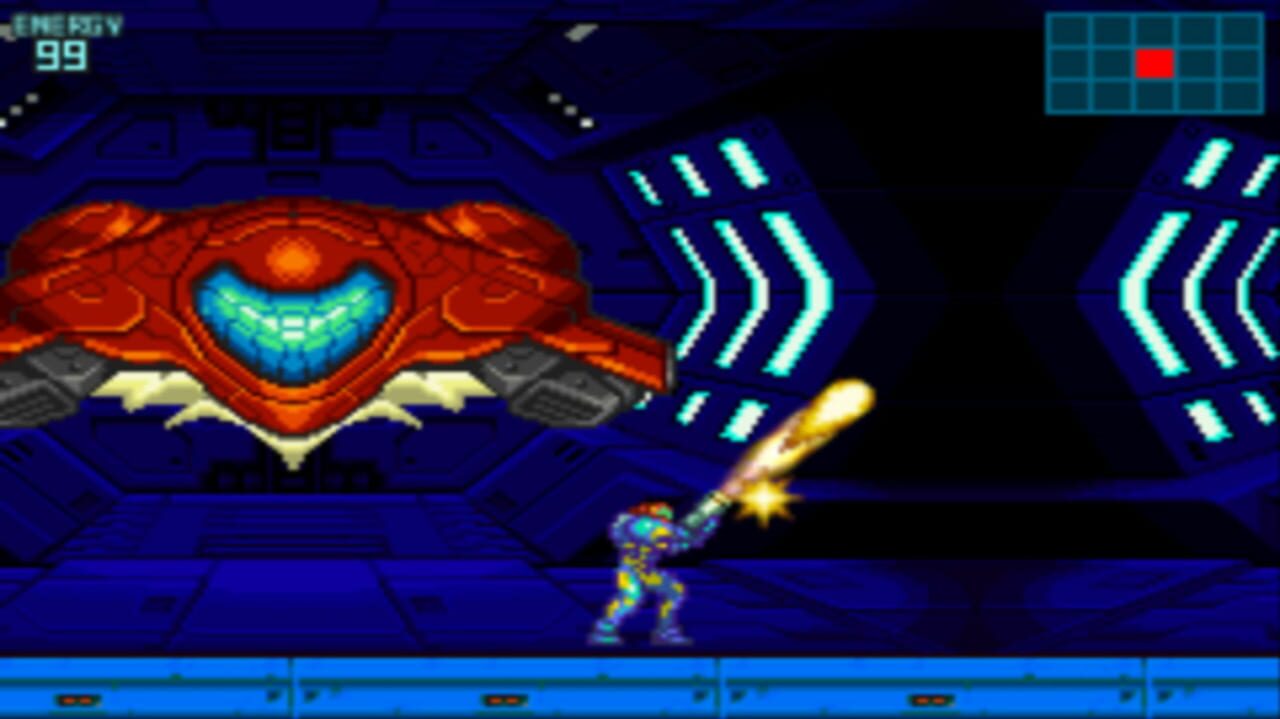
▲ Gameplay & Official Media (Source: IGDB)
A Kafkaesque Metamorphosis as Narrative Climax
The climactic confrontation against the rogue Chozo patriarch Raven Beak elevates this psychological dread into full-blown physical metamorphosis. Driven past the brink of mortality, Samus does not triumph through traditional galactic weaponry or upgraded Chozo engineering. Instead, the dormant Metroid genome violently manifests in a complete physical takeover, encasing her in an organic, chitinous suit that evokes visceral body horror rather than a triumphant power upgrade. This transformation completely subverts the classic Nintendo finale, replacing righteous heroism with terrifying, uncontrollable predation.
During this final sequence, the dynamic between player agency and narrative intent intentionally blurs into discomforting territory. Unleashing devastating energy-draining attacks against Raven Beak feels undeniably exhilarating from a pure gameplay perspective, yet it simultaneously forces players to acknowledge that Samus has crossed an irreversible boundary. She is no longer just a weaponized bounty hunter navigating hostile terrain; she is the apex predator of the cosmos, driven by primal animal instincts that barely obey conscious thought. Escaping Planet ZDR does not resolve this tension, leaving Samus adrift in deep space as a walking biological weapon that the entire galaxy must inevitably fear.
The Direct Lineage to Metroid Ravenous
This thematic turning point now forms the mechanical bedrock for where the series heads next. Following the revelations delivered during the September 9, 2026 Nintendo Direct, the upcoming sequel Metroid Ravenous makes it abundantly clear that MercurySteam has chosen to lean aggressively into the biological consequences established in Metroid Dread. The initial gameplay demonstrations show a bounty hunter whose fundamental combat verbs have mutated from defensive evasion to direct, savage consumption, validating the lingering trauma of that 2021 finale.
- The Shift from Prey to Apex Predator: Life-draining mechanics are no longer confined to narrative cutscenes, fundamentally restructuring resource management and offensive combat loops.
- Erosion of Chozo Technology: The reliance on mechanical arm cannons gives way to organic siphon abilities, reinforcing Samus Aran progressive bodily alienation.
- Isolation from Galactic Civilization: The psychological weight of surviving Metroid Dread leaves Samus completely severed from the Federation, redefining the high-stakes narrative direction moving into 2027.
By treating the finale of Metroid Dread not as a temporary status effect but as an irreversible character metamorphosis, Nintendo and MercurySteam executed one of the most daring narrative pivots in modern gaming history. Samus Aran survival story has permanently evolved from saving the galaxy into surviving herself.
📌 Frequently Asked Questions (FAQ)
Q. Why was the ending of Metroid Dread considered so significant?
A. The ending forced Samus Aran into a full biological transformation into a Metroid, turning her from a hunter into the very parasitic creature she spent her career fighting.
Q. How does the ending of Metroid Dread connect to Metroid Ravenous?
A. Metroid Ravenous directly builds on the predatory body horror of Dread, turning Samus instinctive energy-siphoning abilities into core survival mechanics.
Q. Who developed Metroid Dread alongside Nintendo?
A. Metroid Dread was co-developed by Spanish studio MercurySteam and Nintendo EPD.
The Evolution of Mechanical Narrative
Metroid Dread permanently discarded the comforting illusion of Samus Aran as an uncorrupted galactic protector. By anchoring its late-game combat design to raw body horror, MercurySteam established a brilliant mechanical precedent where the ultimate power fantasy feels like an existential curse. This foundational subversion directly paves the way for the predatory systems shaping the franchise future.
Final Pulse Score: ⭐⭐⭐⭐⭐