
The Legend of Zelda Ocarina of Time Remake has officially unveiled its inaugural gameplay showcase alongside a firm release date of November 5, 2026, for Nintendo Switch 2. Following an initial teaser earlier this summer that merely provided a brief glimpse of young Link in his Kokiri Forest treehouse, this extensive gameplay reveal delivers a comprehensive look at how Nintendo is modernizing the iconic 1998 classic. From fluid environmental navigation to dynamic camera controls, the production balances pure nostalgic reverence with crucial quality of life improvements designed for modern hardware.

▲ Official Cover Art (Source: IGDB)
| Game Title | The Legend of Zelda: Ocarina of Time Remake |
| Platform | Nintendo Switch 2 |
| Release Date | November 5, 2026 |
| Key Features | Dedicated Jump Button, Free Camera, Humming Input |
Modern Control Evolution and Dungeon Traversal
The most immediate shift in moment-to-moment gameplay arrives in the form of a dedicated jump button, completely discarding the rigid auto-jump ledge system of the original Nintendo 64 release. When navigating through the Kokiri Forest and venturing into the Great Deku Tree dungeon, movement feels decidedly more responsive and agile. Link can leap across gaps on command, providing players with direct control over vertical platforming challenges that previously felt strictly automated.
Combat and tool interactions have also received meaningful mechanical upgrades. While Navi returns as a reliable tactical companion offering vital target analysis and enemy guidance, ranged equipment handling has been overhauled. Players can aim the slingshot and subsequent projectile tools using precise motion controls or the standard analog stick. Link himself sports a refreshed visual design, wearing an attire crafted from woven foliage and organic forest materials that ground the opening section in a tangible aesthetic.
Hyrule Castle Town Overhaul and Audio Integration
Exploration within major hubs has undergone a massive structural enhancement. Hyrule Castle Town now completely abandons the pre-rendered backdrops and fixed camera perspectives of the past, granting full 360-degree third-person camera freedom. Players can freely roam alleyways, enter bustling storefronts, and witness dynamic day-to-night lighting transitions directly inside the town square—an environmental feature that was historically locked to Hyrule Field.
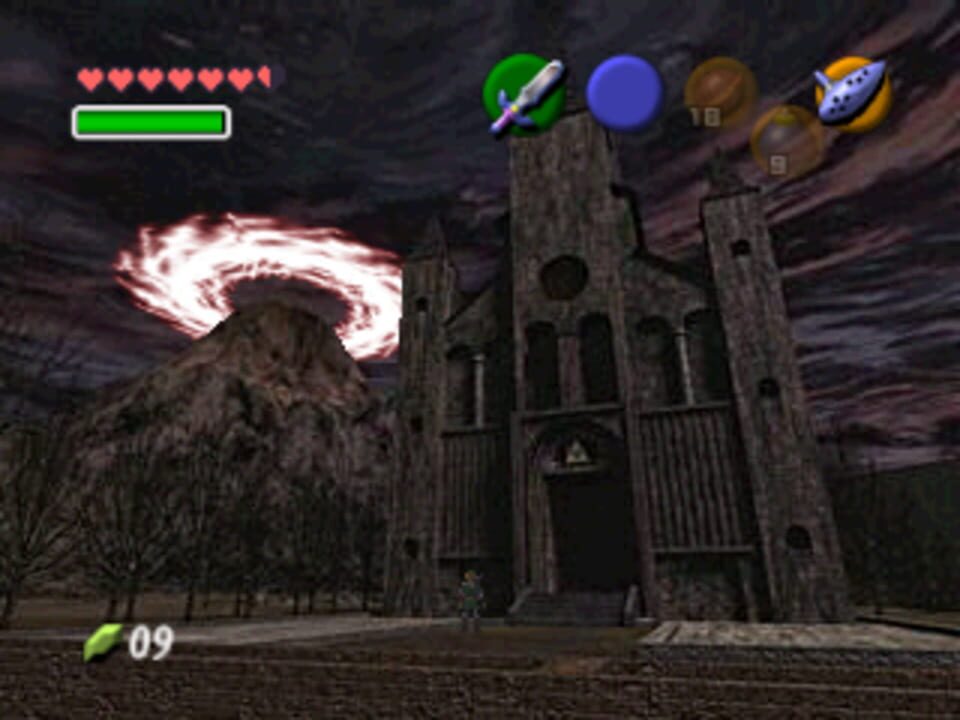
▲ Gameplay & Official Media (Source: IGDB)
Interactive sound mechanics introduce a novel immersion layer through console hardware integration. Adventurers can physically hum learned ocarina melodies into the console microphone to trigger song activation in real time, streamlining spellcasting without pausing the action for complex menu navigation. For narrative progression tracking, Nintendo introduced the Threads of Time feature, a dedicated log where major quest milestones weave into an expanding tapestry to ensure players never lose sight of their objective.
Preserving Classical Pacing in a Modern Engine
Despite these extensive mechanical improvements, Nintendo maintains deliberate design choices to protect the fundamental identity of the adventure. Transition loading zones between distinct sectors, such as moving from Kokiri Forest into Hyrule Field, have been intentionally preserved to mirror the room-by-room pacing and tension of the original masterpiece. This delicate equilibrium ensures that veteran players experience familiar navigational cues while newcomers enjoy modern visual polish and fluid control responsive design.
The Legend of Zelda Ocarina of Time Remake is shaping up to be an essential demonstration of how legendary foundations should be revitalized. By addressing decades-old control constraints while respecting core pacing and dungeon geometry, the title promises to deliver the definitive Hyrule journey on Nintendo Switch 2 this November.
Subtle mechanical refinements preserve classic dungeon tension while delivering vital modernization.
Introducing manual jumping and free camera exploration fundamentally solves the rigid movement limitations of the 1998 classic without compromising spatial puzzles. The optional humming input and dynamic town lighting demonstrate thoughtful hardware utilization that elevates environmental immersion. Preserving discrete zone transitions safeguards original pacing while ensuring modern combat feel remains sharply responsive.
Final Pulse Score: 9.2 / 10
Related Article: Zelda Ocarina of Time Remake Switch 2 Announcement