
While the base game of Elden Ring showcased an “expansion of area” stretching out toward a vast horizon, the DLC ‘Shadow of the Erdtree’ presents a “compression of space” by folding that expanded land layer upon layer. Within a map roughly the size of Limgrave from the base game, FromSoftware has stacked catacombs, abyssal woods, rugged mountain ranges, and a massive fortress like a multi-layered cake. This is not merely a reduction in travel distance, but a revolutionary evolution in level design that forcibly shifts the player’s spatial perception from a 2D plane to a 3D volume.
Instead of planar expansion, the Land of Shadow shifted the paradigm of exploration through vertical density stacked like geological strata.
While the Lands Between map in the base game allowed players to infer rough paths using just a 2D plane, the Land of Shadow map thoroughly deceives the player’s eyes. Even if areas appear adjacent on the map, they are often separated by cliffs with hundreds of meters in elevation difference, requiring entirely different routes to reach. Through this structure, FromSoftware blocked the simple solution of “running in a straight line to the destination” typical of open worlds, maximizing the density of exploration by forcing players to scour hidden paths in cliff crevices or behind waterfalls.
At the pinnacle of this vertical design stands the massive Legacy Dungeon located in the center, the ‘Shadow Keep.’ This castle is not merely a final destination to defeat the boss, Messmer the Impaler, but acts as a gigantic roundabout connecting various altitudes of the map. It boasts an organic structure where the exterior areas you can reach (such as the Ancient Ruins of Rauh, the Recluses’ River, or the Scaduview) change entirely depending on which entrance you take—the main gate, the flooded Church District, or a hidden underground passage.
The map structure that blurs the boundaries between Legacy Dungeons and the open field is a perfect modern succession of the organic shortcut design from the ‘Dark Souls 1’ era.
If the open field and Legacy Dungeons existed as clearly segmented spaces in the base game, that boundary becomes extremely blurred in the DLC. The rugged mountain paths of the Jagged Peak themselves function as a giant natural dungeon, and an underground exploration starting from Belurat’s gaol seamlessly connects to a completely different field after passing through a poison swamp. The thrill of discovering the light of a familiar early-game Site of Grace beyond a door opened after hours of wandering is akin to recreating Lordran of ‘Dark Souls 1’—often cited as the greatest map design in video game history—with the technology of 2026.
| Comparison Item | Base Game (Lands Between) | DLC (Land of Shadow) |
|---|---|---|
| Spatial Design Focus | Horizontal radial expansion (Vast area) | Vertical stratified compression (Maximized elevation difference) |
| Relationship Between Dungeons and Fields | Clearly separated hub format | Organic network with blurred boundaries |
| Role of the Map | Intuitive 2D navigation | Visual puzzle with omitted altitude info |
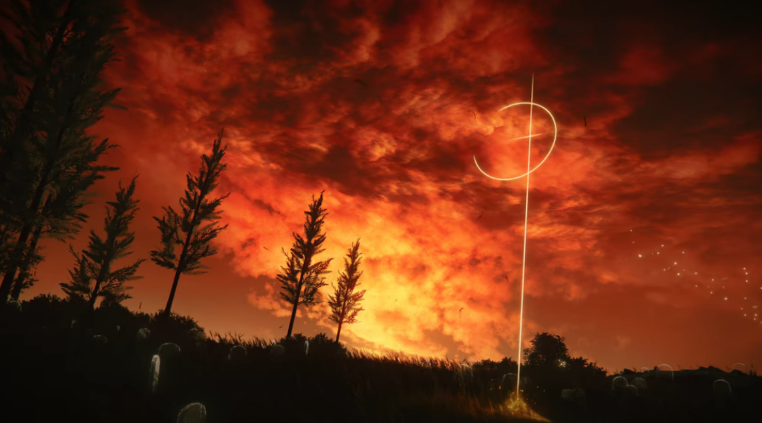
To navigate terrain with extreme elevation changes, players must recognize the planar limits of the 2D map and read hidden paths through visual cues.
To decipher this grueling multi-layered structure, the keys FromSoftware handed to the player are the leaping ability of the spectral steed, Torrent, and the utilization of sealed ‘Spiritsprings.’ In certain areas, you must destroy rock piles to activate a blocked Spiritspring before you can soar up a cliff tens of meters high. This goes beyond simply providing travel convenience; it is an exploration gimmick designed to encourage players to closely observe landmarks and solve environmental puzzles.
Therefore, the way veteran users navigate the Land of Shadow does not begin with blind faith in the map, but rather with the act of standing at the edge of a cliff and looking for protruding tombstones or branches below. Even in an abyssal void where a fall seems to mean instant death, cleverly designed routes allow you to step down, and at the end, rare Ashes of War or Incantation rewards are always waiting. This is the most primal and thrilling “sense of adventure” that FromSoftware forces upon users through its unkind level design.
Related analysis can be found in the Full Series Analysis.
Conclusion: The Aesthetics of Spatial Design Breaking Boundaries
The level design of ‘Shadow of the Erdtree’ is the culmination of spatial design know-how FromSoftware has accumulated over the past 15 years. If the base game was a form of plotting numerous dots (dungeons) across a wide plain, the DLC intricately wove those dots together with 3D threads to create a single massive knot. We willingly endure hours of detours—piercing through dark dungeons, crossing mountains, and riding down waterways—just to reach an area physically located a mere centimeter away on the map. We do this because the spatial epiphany of realizing “this place was connected to that place all along,” encountered at the end of that agonizing detour, delivers a catharsis far more intense than severing any boss’s head. The Land of Shadow has proven the absolute limits of intellectual pleasure that video game spaces can provide.
View Full Series List