
Carcass Clad has officially emerged from the shadows as the next ambitious project from Wrong Organ, the creative minds behind the psychological hit Mouthwashing. This newly announced title pivots the developer’s signature atmospheric dread into the realm of cooperative gameplay, challenging three players to operate a massive armored vehicle known as the Yksio. Set against the backdrop of Vhorgorod, a city ravaged by a relentless war and haunted by unknown entities, the game promises a high-stakes blend of resource management and tactical survival. Unlike traditional shooters, this experience emphasizes the physical reality of being trapped inside 70 tons of steel, where every lever and dial requires manual intervention to function.
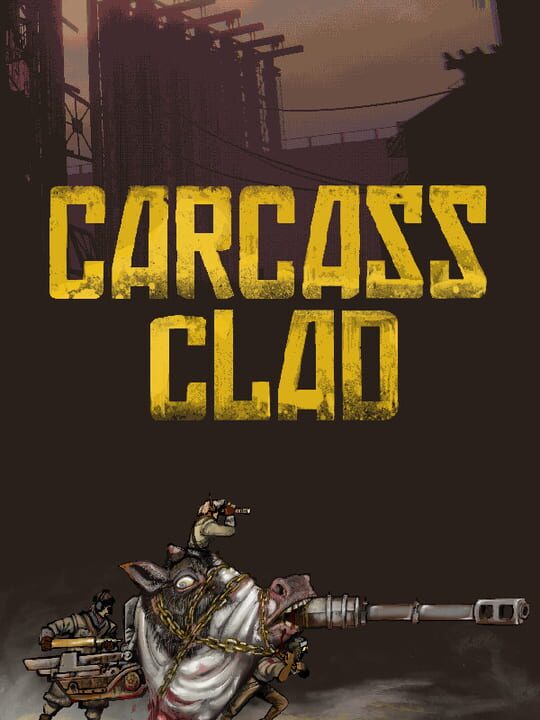
▲ Official Cover Art (Source: IGDB)
| Feature | Details |
|---|---|
| Developer | Wrong Organ |
| Platform | PC (Steam) |
| Player Count | 3-Player Cooperative |
| Genre | Tactical Tank Horror |
| Release Date | To Be Announced |
The Claustrophobic World of Vhorgorod and the Yksio
The setting of Carcass Clad is far from a typical battlefield, as Vhorgorod serves as a decaying tomb where survival is a luxury rather than a guarantee. Players are confined to the Yksio, a tank that is described as a claustrophobic box of rusted metal and grinding gears. The environmental storytelling suggests a world where the encroaching war has mutated into something far more sinister than mere geopolitical conflict. The developer emphasizes that while the tank offers a semblance of safety, the horrors dwelling within the city ruins are constantly searching for a way in. This creates a dual-layered fear: the external threat of the unknown and the internal anxiety of mechanical failure.
Exploration in this war-torn landscape is driven by necessity, forcing players to leave the relative safety of their armored shell to scavenge for fuel and ammunition. These resources are scarce, and the decision to stop the tank to retrieve supplies is fraught with risk. The atmosphere is designed to be thick with tension, utilizing audio cues and limited visibility to keep the crew on edge. By focusing on a single vehicle as the primary setting, the game heightens the sense of isolation, making the three-person crew entirely dependent on one another for their continued existence.
Mastering the Diegetic Mechanics of Carcass Clad
What sets Carcass Clad apart from other cooperative horror games is its commitment to fully diegetic mechanics. In this game, there are no floating HUD elements or magical inventory screens to assist the players. Instead, every action within the Yksio must be handled manually through tactile interactions. Whether it is shifting gears, ranging targets through a periscope, or loading a massive 158mm cannon, the crew must physically interact with the machinery around them. This level of immersion ensures that communication becomes a gameplay mechanic in itself, as players must relay information that only their specific station can see or hear.
▲ Official Artwork (Source: IGDB)
Breaking Down the Crew Roles
The gameplay is strictly divided into three distinct roles, each essential for the tank’s operation. Kanerva serves as the Commander, acting as the eyes and ears of the Yksio. With extremely limited visibility for the rest of the crew, Kanerva must use a periscope and radio to chart routes and identify threats. The success of the mission rests on her ability to keep a cool head and issue precise orders under fire. If the Commander fails to range a target correctly or loses track of the environment, the entire crew is left blind to the dangers surrounding them.
Erkki takes on the role of the Gunner, managing the Yksio’s primary offensive capabilities. Beyond just firing the 158mm cannon, Erkki is responsible for processing scavenged supplies and managing the inventory carousel. Because ammo is limited, the Gunner must ensure that every shot is calculated and effective. Meanwhile, Taisto handles the Driving duties, managing the V10 engine. This role involves more than just steering; Taisto must balance power allocation across the tank’s various systems and manage fuel consumption. A careless driver can easily make the tank an easy target or leave the crew stranded in the middle of a hostile zone.
Survival Through Scarcity and Tactical Coordination
Combat in Carcass Clad is described as deliberate and tense, favoring strategy over reflex-based gunplay. The Yksio is a powerful machine, but its 70-ton weight makes it unwieldy and vulnerable if handled without care. Groups will need to decide when to engage and when to retreat, as ammunition is often too precious to waste on every encounter. This tactical depth forces a layer of management where the crew must weigh the potential gains of a fight against the very real possibility of running out of fuel or being overwhelmed by the horrors of Vhorgorod.
The horror elements are deeply integrated into these survival systems. The sounds of grinding gears and the claustrophobic interior of the tank are meant to be as unsettling as the enemies outside. If a crew member fails to balance their share of the responsibilities, the Yksio will come to a grinding halt, leaving the players exposed to whatever is dwelling in the shadows. This dependency creates a unique social dynamic where mistakes ripple through the entire team, leading to a mounting sense of panic that characterizes the best experiences in the horror genre.
Carcass Clad redefines cooperative horror through mechanical intimacy and high stakes dependency
By removing traditional UI and forcing players to interact with a physical machine, Wrong Organ is creating a localized horror experience that relies on social friction. The transition from the narrative focus of their previous work to this systems-driven tank simulation suggests a deep evolution in their design philosophy. This title will likely appeal to fans of high-fidelity simulators who crave the added tension of a supernatural threat and the chaos of mandatory teamwork. It is a bold direction that leverages the strengths of niche simulation games to enhance the vulnerability inherent in survival horror.
Final Pulse Score: 8.8 / 10