
Elden Ring’s combat has evolved beyond simply dodging enemy attacks and waiting for openings, transforming into an interactive exchange of offense and defense where actively controlling the enemy’s stance leads to devastating critical hits. While previous Souls series relied heavily on extreme evasive maneuvers like rolling and parrying, this title introduces new axes—jump attacks and guard counters—to expand the combat tempo dimensionally. This mechanical shift acts as the core driving force that prevents players from being unilaterally swept away by enemy patterns, allowing them to seize the initiative through aggressive positioning.
Separating the two metrics of poise and stance is an exceptionally clever choice from a level design perspective. Even amidst the delayed, off-beat attacks of powerful bosses, players can somehow accumulate stance damage to turn the tide of battle, which allows them to overcome the genre’s notoriously high entry barrier through a deep understanding of the system. Consequently, combat has been incorporated into the realm of precise calculation of frames and stats, rather than a mere physical test of reflexes.
Elden Ring’s enemies possess independent stance and stagger resistance values, and breaking these enables a critical hit.
Internally within the system, the stagger resistance of both players and enemies is managed as separate values called poise and stance, and when an enemy’s stance is completely broken, they enter a state vulnerable to a critical hit. FromSoftware has deployed jump attacks and guard counters as specialized techniques to chip away at this invisible gauge. A guard counter is triggered by inputting a heavy attack immediately after blocking an enemy’s strike with a shield or weapon; although its raw damage may be lower than a two-handed jumping heavy attack, its poise damage is designed to be significantly higher.
This shattered the past paradigm of blindly rolling away from large enemies, creating an opportunity to actively utilize the guarding capabilities of armor and shields. Formidable foes, including Demigods, will not have their stance broken by a single successful parry, requiring multiple successful parries instead, which forces a playstyle of continuous pressure mixing guard counters and jump heavy attacks.
The ‘Ashes of War’ and ‘Spirit Ashes’ systems are the tactical core that transcends the physical limits of weapons and maximizes the player’s survivability.
Whereas past titles forced players to adapt to fixed weapon skills, Elden Ring separated skills and weapon affinities through Ashes of War. With the exception of special weapons upgraded with Somber Smithing Stones, the vast majority of standard weapons can have their Ashes of War swapped at any Site of Grace to change their combat skills. This means that even the same straight sword can be modified into an Intelligence-based magic sword or a Faith-based fire sword, creating extreme build diversity.
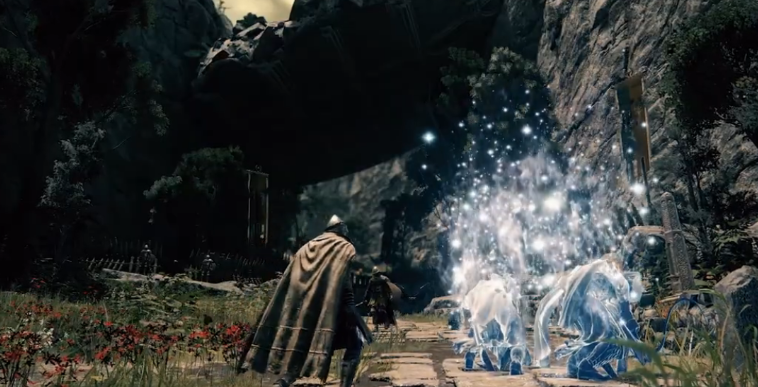
Furthermore, the spirit summoning system via Spirit Ashes is an innovation that completely reshaped the difficulty curve of single-player gameplay. Spirits, which can be upgraded at the Roundtable Hold, possess clear roles such as melee specialists, ranged specialists, and healers. When facing sections swarming with enemies or bosses with extreme aggression, it became possible for a mage character to unleash spells from the rear while being protected by a vanguard of summoned allies.
| Combat System Element | Core Mechanism | Tactical Utility |
|---|---|---|
| Guard Counter | Triggers a high poise-damage attack immediately after guarding | Safe and proactive induction of stance breaking |
| Ashes of War | Grants combat skills and affinity modifications to standard weapons | Extreme build customization tailored to stat optimization |
| Spirit Ashes | Summons AI allied spirits in designated areas | Disperses boss aggro and compensates for weaknesses in combat styles |
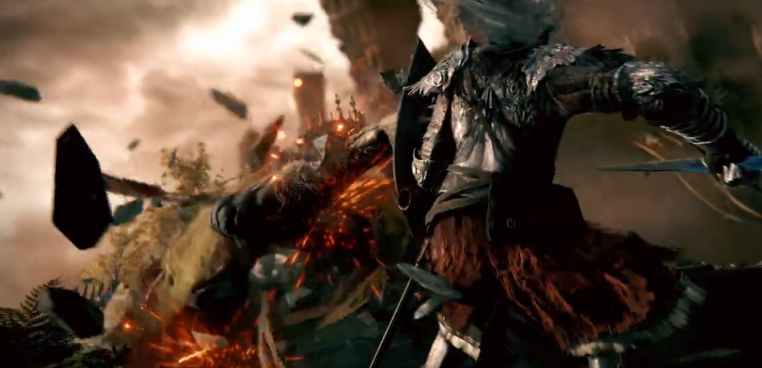
The solution to penetrating high aggression lies not in passive evasion, but in aggressive positioning and the aggro dispersion of spirits.
Moving into the Shadow of the Erdtree DLC areas, the aggressiveness of bosses is maximized beyond comparison to previous works, chasing down players in an instant even if they create distance. As the potential damage output per second increased due to the buffed power of combat skills, the actual attack windows allowed by bosses were designed to be extremely short for the sake of balance. Thus, it can feel like a tiring war of attrition is forced upon the player, taking 3 to 4 hits just to land 1.
The most reliable tip to overcome this unreasonableness is utilizing aggro ping-pong through highly upgraded spirits and wielding colossal weapons. Colossal weapons can induce guaranteed staggers on almost all monsters, excluding the Horned Warrior types, allowing you to seize the initiative. Moreover, the core insight of veterans is to never miss the moment the spirit draws the boss’s gaze, using that opening to execute Ashes of War or jump heavy attacks with high stance damage from the rear. Ultimately, Elden Ring is not a game that breaks the more you charge in, but a game that reveals its openings only when you design the battlefield using every card dealt to your hand.
Related analysis can be found in the Full Series Analysis.
Conclusion: Transition from Passive Survival to Active Destruction
The point where Elden Ring’s combat design diverges from past Soulslikes is precisely the ‘player’s power of intervention.’ While the past was a passive survival drama where one had to memorize massive enemy patterns and roll with perfect timing to stay alive, Elden Ring is an active siege warfare where you shatter poise, divert attention with spirits, and destroy elemental disadvantages with Ashes of War. This was the driving force that unlocked the shackles of the so-called ‘difficult game’ and led a wider audience to the Lands Between. The reason we refuse to put down the controller despite dying countless times to delayed attacks is, ultimately, for that single moment of destructive catharsis when the gears of this system perfectly interlock to bring a colossal enemy to its knees before us.
View Full Series List