
In an era where puzzle platformers frequently rely on gear treadmills and unlockable traversal tools to gate progression, Nonolith arrives with a refreshingly austere philosophy. Developed by indie creator Justcamh, this cerebral 2D adventure drops players into the boots of an unassuming gnome trapped inside an intimidating, shifting mega-structure. Rather than trickling out upgrades across hours of backtracking, the title presents its entire mechanical palette upfront, relying on pure spatial intellect and environmental tampering to drive its journey forward.
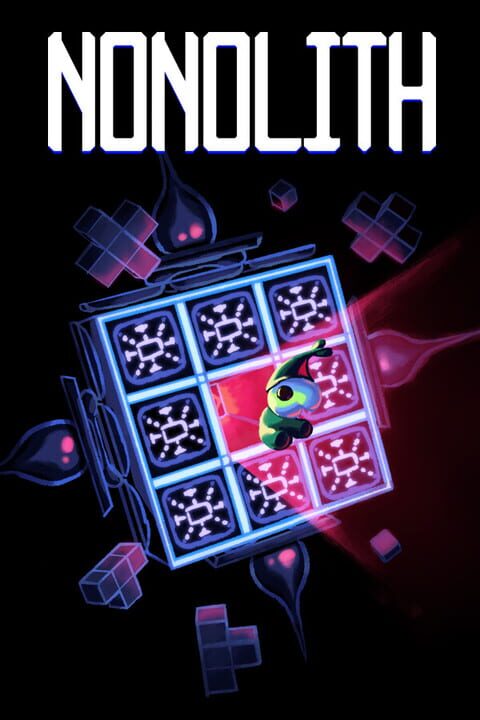
▲ Official Cover Art (Source: IGDB)
Living Edifice Architecture and the 3×3 Structural Grid
The core structural conceit of Nonolith centers on a monolithic 3×3 labyrinth divided into nine interconnected regional chambers. Each sector functions as an intricate mechanical diorama populated by responsive stone architecture, shifting hazards, and complex contraptions like mechanical pistons that shove solid masonry across the room. Because every room is bound to this overarching nine-part grid, navigating the layout feels less like clearing isolated puzzle rooms and more like deciphering the architectural logic of an ancient, sleeping machine.
Escaping this colossal prison serves as the baseline objective, but the environment makes it clear from the opening moments that straightforward evacuation merely scratches the surface. The geometry itself teases unseen shortcuts, mysterious structural dead-ends, and hidden pathways designed for players willing to deconstruct their surroundings rather than simply traverse them. By providing multiple viable routes across its nine worlds, the title invites non-linear experimentation, rewarding those who treat each room as an editable diagram rather than a static platforming gauntlet.
| Developer | Justcamh |
| Genre | 2D Puzzle Platformer / Environmental Manipulation |
| Core Mechanics | Tile Cutting, Copy-Pasting, Rotation, Spell Patterns |
| World Layout | Nine Interconnected Chambers (3×3 Grid) |
| Platform | PC (Steam) |
The Geometry of Copy and Paste: Redefining In-Engine Problem Solving
Rather than equipping the avatar with traditional grappling hooks or elemental projectiles, Nonolith places the powers of a digital editor directly into player hands. Alongside agile running and leaping, you are given the uncanny ability to pick up, rotate, crop, duplicate, and delete chunks of the terrain in real time. If a sheer precipice bars your path forward, slicing out a segment of hanging stone and pasting it at your feet provides an instant makeshift staircase. If an impenetrable wall blocks an exit, lifting the barrier entirely out of its socket neutralizes the threat without breaking a sweat.

▲ Gameplay & Official Media (Source: IGDB)
This sandbox approach completely reconfigures the mental model typical of 2D puzzle designs. Instead of searching for the developer-sanctioned single key for a specific lock, players routinely discover improvisational solutions through spatial editing. However, this editor power is bounded by deliberate spatial rules. Manipulating the physical architecture alters gravitational lanes, piston momentum, and physical pathways, forcing players to anticipate secondary chain reactions before slicing away crucial load-bearing tiles.
- Precision Editing: Freely copy, shift, rotate, and delete geometric blocks to construct custom traversal routes across hostile gaps.
- Hidden Terrain Magic: Discover occult environmental spells by reassembling specific stone glyphs and block patterns across the chambers.
- Kinetic Physics Interactions: Leverage dynamic props like pistons to propel rearranged blocks through narrow tunnels and activate switches.
- True Agency Over Artificial Locks: Tackle nine multi-path sectors where puzzle solutions emerge entirely from player ingenuity rather than ability gates.
Knowledge Versus Progression: Why the Zero-Unlock Ethos Matters
The defining strength of Nonolith lies in its utter contempt for conventional power progression. In many modern Metroidvanias and environmental puzzlers, progress is strictly gatekept by synthetic upgrades, such as double-jump boots, dash boots, or strength bracelets. Here, the gnome holds identical capabilities in the opening minute as they do in the climactic endgame. Progression is purely cognitive, meaning the player grows solely by deciphering the world’s hidden grammar, understanding mechanical interactions, and unearthing occult spells formed by arranging tiles into exact visual configurations.
This design choice elevates Nonolith into the revered category of knowledge-gated masterworks, where the boundary between novice and master is defined entirely by comprehension. With a public demo already playable on Steam ahead of its full launch later this year, the game presents a bold challenge to genre veterans who hunger for uncompromised logic, lateral thinking, and the sublime thrill of tearing apart a game world piece by piece.
📌 Frequently Asked Questions (FAQ)
Q. What is the primary core mechanic in Nonolith?
A. Nonolith allows players to manipulate the game world by copying, pasting, rotating, moving, and deleting pieces of terrain in real time to solve puzzles and create custom traversal pathways.
Q. Does Nonolith feature unlockable gear or abilities?
A. No, Nonolith avoids unlockable upgrades entirely. Every tool and manipulation power is accessible from the start, making player knowledge and spatial comprehension the sole driving force of progression.
Q. When is Nonolith releasing and where can it be played?
A. Nonolith features a playable demo currently available on Steam, with the full game scheduled to launch on PC later this year.
The Tectonic Shift in Knowledge-Driven Puzzle Architecture
By stripping away arbitrary ability unlocks, Nonolith forces players to engage directly with structural physics and visual literacy. The transition from mere survival to total environmental dominance hinges entirely on recognizing hidden patterns and glyph arrangements that existed in plain sight all along. This purity of mechanical logic ensures that every breakthrough feels earned through genuine spatial mastery rather than passive character stat scaling, setting a compelling benchmark for modern puzzle platforming.
Final Pulse Score: ⭐⭐⭐⭐☆