
For more than half a decade, Ryu Ga Gotoku Studio has operated under a strict cross-generational development pipeline, delivering expansive urban brawlers while tethered to legacy machine specifications. That constraint officially ends with Stranger Than Heaven, an ambitious historical action adventure designed from the ground up purely for modern console hardware and personal computers. By severing ties with previous generation systems like the PlayStation 4, the studio is finally poised to realize its uncompromised creative ambitions without lowering crowd density or throttling simulation complexity.

▲ Official Cover Art (Source: IGDB)
Breaking Free from the Cross Generation Bottleneck
Since the advent of modern consoles in 2020, RGG Studio continued catering to legacy hardware to maintain broad commercial reach across global player bases. Blockbusters such as 2024’s Like a Dragon: Infinite Wealth maintained parity across generational divides, and while the Xbox One version was shelved earlier for Yakuza Kiwami 3 & Dark Ties, the lingering presence of PlayStation 4 support demanded architectural concessions. In past productions, severe hardware memory bottlenecks forced developers to drastically limit character render counts and scale back environmental density. The decision to construct Stranger Than Heaven exclusively for PlayStation 5, Xbox Series X|S, and PC eliminates these legacy trade-offs, providing the development team with the memory bandwidth required for high fidelity rendering.
| Developer | RGG Studio |
| Target Platforms | PlayStation 5, Xbox Series X|S, PC |
| Release Date | January 15, 2027 |
| Historical Setting | Early 20th Century Japan |
| Core Engine Leap | High Density NPC Crowds and Native High Res Assets |
Reconstructing Early 20th Century Japan at Full Scale
The elimination of older hardware specifications directly fuels the intricate worldbuilding of Stranger Than Heaven, which follows a journey spanning multiple decades across early 20th century Japan. Historic districts such as 1915 Kokura in Fukuoka and 1943 Minami in Osaka are presented with unprecedented architectural depth and lighting realism. Rather than traversing sparsely populated corridors masked by strategic camera angles, players encounter bustling pre-war and wartime streets bursting with fully modeled city inhabitants. Producer Hiroyuki Sakamoto confirmed that modern hardware capabilities allowed the studio to raise character model fidelity across the board while rendering vastly larger groups of simultaneous on-screen entities.
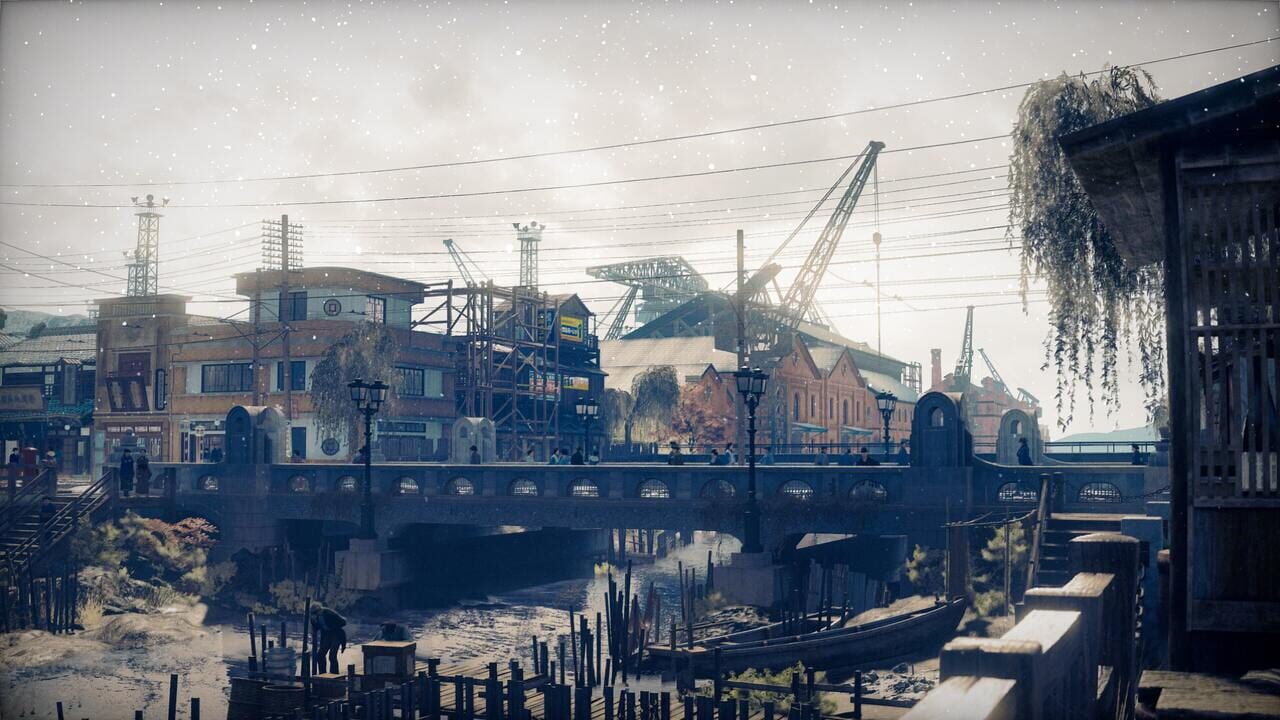
▲ Gameplay & Official Media (Source: IGDB)
Mechanical Innovations and Modern Combat Accessibility
Freed from memory allocation limits, the combat and environmental systems inside Stranger Than Heaven leverage real-time physics interactions and expanded enemy group aggression patterns. Crowd density is not purely cosmetic; larger numbers of combatants create unpredictable, high-stakes skirmishes across dynamic city avenues. Alongside these complex encounter designs, the development team has integrated optional built-in combat modifiers and gameplay toggles to ensure the multi-generational storyline remains accessible to players who prioritize narrative over grueling execution tests. The inclusion of native gameplay assistance parameters demonstrates a mature design approach, pairing technical spectacle with tailored player agency.
- True Native Fidelity: High resolution asset streaming ensures zero texture popping across crowded Japanese metropolises.
- Exponential NPC Density: Modern hardware architecture handles massive civilian populations and active enemy encounters simultaneously.
- Integrated Accessibility: Built-in optional modifiers grant players granular control over combat difficulty and pacing.
- Uncompromised Vision: Complete abandonment of legacy hardware removes historical simulation and environmental draw-distance limitations.
The historical scope of Stranger Than Heaven demands absolute authenticity, capturing the evolving sociopolitical climate and physical architecture across distinct decades. Early gameplay previews reveal a cinematic texture and atmospheric gravitas that set this project apart from contemporary crime dramas, even as the narrative takes bold thematic swings including a digital rendition of late cultural figures like Tupac Shakur. With the scheduled release date set for January 15, 2027, the project represents the definitive technological graduation for RGG Studio, transitioning from beloved cross-generational workhorse to cutting-edge technical innovator.
📌 Frequently Asked Questions (FAQ)
Q. What platforms will Stranger Than Heaven release on?
A. Stranger Than Heaven is launching exclusively on PlayStation 5, Xbox Series X|S, and PC, completely dropping previous generation consoles such as the PlayStation 4 and Xbox One.
Q. When is the official release date for Stranger Than Heaven?
A. The game is scheduled for worldwide release on January 15, 2027.
Q. How does dropping legacy platforms improve Stranger Than Heaven?
A. By targeting modern hardware natively, the development team eliminated memory constraints, enabling significantly higher NPC crowd densities on screen, richer character models, and expansive early 20th century Japanese environments.
The Strategic Necessity of Leaving Legacy Hardware Behind
By officially dropping previous generation consoles, RGG Studio resolves its longest-running design bottleneck. Cross-gen parity held back crowd simulation and asset fidelity for years across the Like a Dragon lineage. Dedicating production strictly to modern console hardware ensures that the dense historical districts of early 20th century Japan feel alive rather than sterile. This transition establishes a vital technical baseline that will dictate the studio’s mechanical and architectural standards for the remainder of this console cycle.
Final Pulse Score: ⭐⭐⭐⭐☆