
Thief: The Dark Project Remastered offers far more than an updated visual layer for modern gaming rigs, functioning instead as a genuine piece of software archaeology that pulls back the curtain on legendary stealth engineering. As technical teams dive deep into the vintage version control repositories of Looking Glass Studios, they are uncovering the chaotic, brilliant foundation that birthed the immersive sim genre. The historical Dark Engine codebase reveals a development cycle driven by impossible deadlines, radical rendering experiments, and raw programming audacity.

▲ Official Cover Art (Source: IGDB)
| Attribute | Detail |
|---|---|
| Project Title | Thief: The Dark Project Remastered |
| Original Developer | Looking Glass Studios |
| Core Engine | Dark Engine |
| Remaster Studio | Nightdive Studios |
| Key Tech Influence | Quake Lighting Architecture |
| Visibility System | Real Time Portal Occlusion |
| Platform Availability | Steam, GOG, Epic Games Store |
The Secret Architecture Behind Thief: The Dark Project Remastered
Examining the original source code reveals that the Dark Engine was fundamentally built upon technical shortcuts that somehow coalesced into groundbreaking gameplay. Engineering logs show that development splintered midway through production, forcing a secondary team to salvage and restructure systems right before shipping. Software engineer Josh Dowell highlighted that the code is filled with desperate developer notes, including direct warnings labeling routines as emergency trade show workarounds that were never deleted and persisted well into subsequent sequels.
These frantic programming solutions were not signs of incompetence, but rather high stakes survival maneuvers in an era when 3D game engines were evolving every few months. The original programmers faced immense memory and compute constraints while trying to deliver unprecedented stealth dynamics. When examining Thief: The Dark Project Remastered from an architectural standpoint, one realizes that the tactile tension players felt in 1998 was powered by systems held together by sheer willpower and improvisational coding.
How Dark Engine Mutated Quake Rendering Tech
At the technological core of the game lies a startling rendering lineage that directly mirrors id Software landmark first person shooter. The fundamental way light entities behave, emit illumination, and toggle states across surfaces is an exact mechanical clone of the lighting pipeline seen in Quake. However, the path divergence occurred in how both engines handled player visibility and room rendering across complex interior environments.
While id Software relied on precomputed visibility matrices to guarantee high framerates on vintage hardware, Looking Glass opted for an absurdly ambitious real time portal system. Every doorframe and corridor boundary acted as a dynamic viewport calculating recursive visibility on the fly, rendering only the geometric volumes visible through interconnected doorways. Executing such continuous mathematical calculations in real time on 1998 consumer processors was practically unheard of, explaining both the notorious performance quirks and the unmatched environmental immersion.
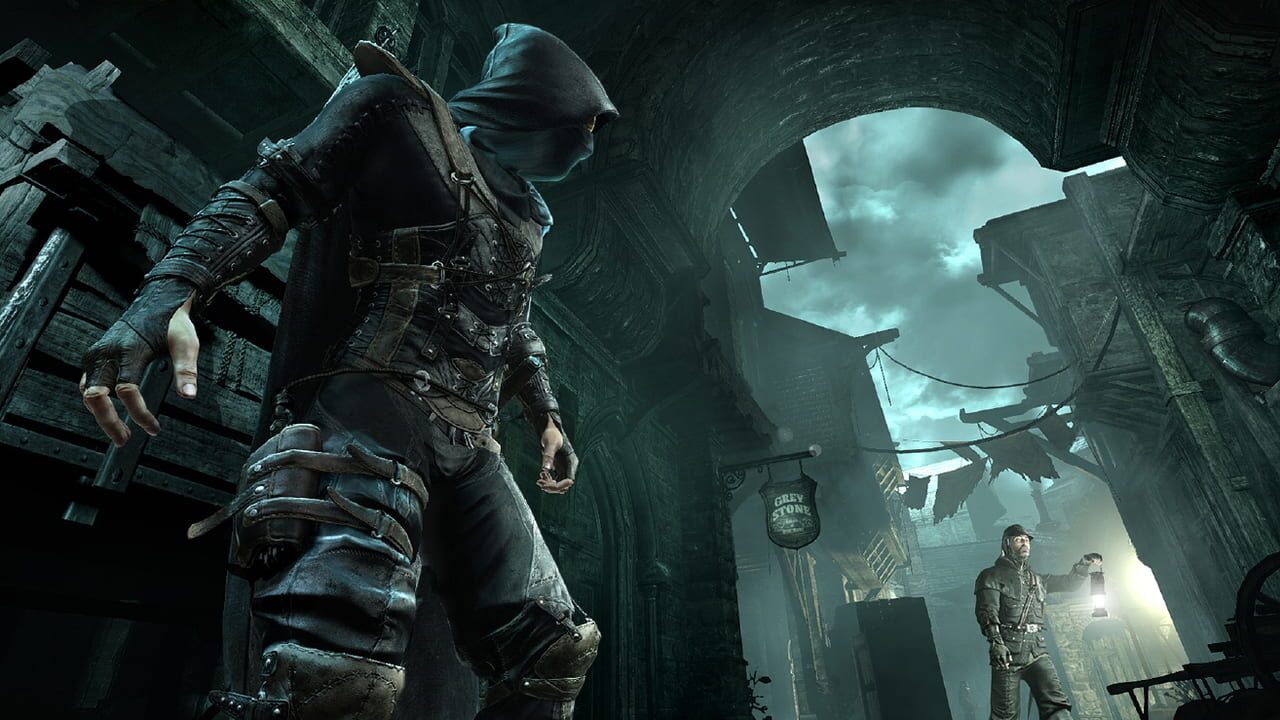
▲ Gameplay & Official Media (Source: IGDB)
The Gameplay Impact of Legacy Engine Preservation
Understanding these legacy systems is critical for modern players tracking Thief: The Dark Project Remastered on platforms like Steam. Preserving the delicate balance of light visibility, dynamic propagation, and sound propagation requires respecting the erratic nature of the original codebase rather than completely replacing it with generic modern rendering suites. Modernizing the game without breaking Garrett stealth detection requires surgical code refactoring that honors every historic hack.
The engineering lessons embedded within Thief: The Dark Project Remastered show how structural imperfections often create unforgettable emergent experiences. By preserving the portal logic and lighting quirks that made shadows feel truly alive, the upcoming release ensures that the soul of immersive stealth design remains completely intact for modern audiences.
Preserving historic engine idiosyncrasies is essential for authentic stealth mechanics.
The Dark Engine legacy proves that systemic immersion often emerges from unconventional technical solutions rather than sanitized modern code structures. Maintaining the real time portal occlusion and raw Quake lighting parity guarantees that Garrett shadow detection feels authentically sharp and responsive. The ultimate value of this restoration project lies in its willingness to preserve historical software oddities while eliminating legacy crashes for current hardware platforms.
Final Pulse Score: 9.0 / 10
Related Article: Thief Dark Project Remastered Developer Return