
Grand strategy enthusiasts have long debated how Creative Assembly would reconcile the massive planetary scale and grim lore of the 41st Millennium with traditional turn-based empire management. The extensive extended Alpha Strike demonstration of Total War Warhammer 40000 provides our clearest look yet at the strategic layer, illustrating a deliberate departure from old map-painting formulas in favor of system-by-system warfare, fragile political trust, and severe transhuman unit scarcity.
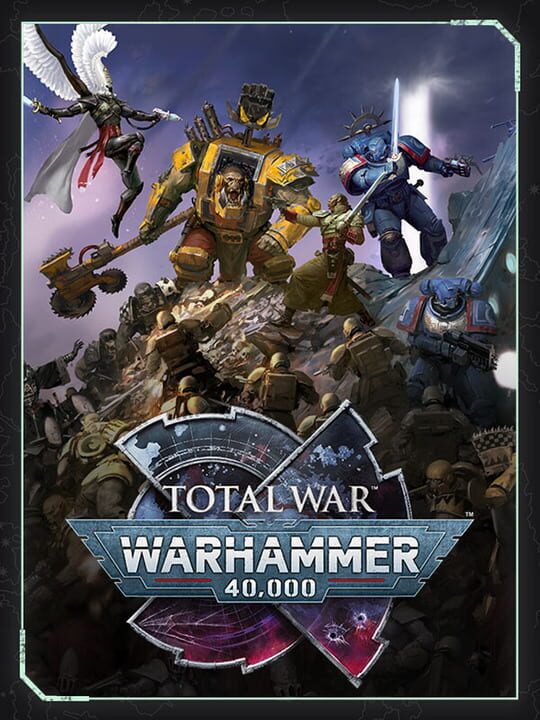
▲ Official Cover Art (Source: IGDB)
System-Driven Theatres and Narrative Pacing
Rather than dropping players onto a single gargantuan continental map, Total War Warhammer 40000 structures its grand campaign around distinct solar systems that act as self-contained operational theatres. In the featured Praevoss system engagement, an Ultramarines strike force arrives mid-campaign to purge an Ork infestation across three conquerable worlds, navigating around unusable dead zones and massive gas giants. Each operational theatre functions as an isolated mini-campaign where commanders secure victory conditions before advancing forward, carrying over only select elite assets, veterancy, and fleet structures into subsequent theatres.
This modular system design directly addresses the classic late-game fatigue that has plagued grand strategy titles for over a decade. By enforcing operational resets between multi-planet systems, the campaign meta maintains high tactical tension and prevents players from steamrolling the galaxy through sheer economic momentum after the initial opening turns.
The Grind of Attrition and Transhuman Scarcity
True to the foundational lore, Space Marines cannot simply replenish dozens of battlefield casualties in standard province garrisons between turns. The creation of an Astartes warrior requires extensive surgical indoctrination and finite gene-seed stockpiles, forcing players commanding the Adeptus Astartes to manage battle fatigue far more rigorously than horde factions. While fallen battle-brothers with non-fatal wounds gradually recover thanks to transhuman anatomy, heavy losses cannot be instantly recruited back from freshly captured planetary outposts.
Severely wounded commanders and pivotal fallen heroes present an agonizing tactical choice between permanent retirement or entombed preservation inside hulking Dreadnought chassis to preserve their battlefield command aura. Reinforcing frontline battlelines requires summoning reserves directly from the fleet overhead, deploying drop pods straight into contested tactical zones mid-skirmish to turn the tide.

▲ Gameplay & Official Media (Source: IGDB)
Planetary Suspicion versus Imperial Influence
Conquering territory in Total War Warhammer 40000 is not a clean administrative transition, particularly when dealing with stubborn Planetary Governors who mistrust genetically altered warrior monks. Every aggressive campaign action yields severe diplomatic repercussions through the dual metrics of Suspicion and Influence. Scouring liberated battlefields yields immediate Requisition currency to fund supply lines, but it alarms civilian administrators who fear Space Marine overreach.
- Orbital Bombardment Toll: Calling down heavy ship-based macro-cannon strikes softens hostile xenos fortifications instantly, but inevitably causes civilian collateral damage that spikes local Suspicion.
- Planetary Alignment: Restraining orbital fury and respecting local planetary leadership maintains low Suspicion, steadily accumulating Influence points.
- Auxiliary Reinforcements: High Influence allows Adeptus Astartes forces to requisition mortal planetary defense regiments, screening valuable Space Marines from frontline attrition.
| Campaign Mechanic | Operational Meta Impact |
|---|---|
| Theatre Soft Resets | Prevents monotonous late-game map bloat by isolating campaign objectives to distinct planetary systems. |
| Astartes Logistics | Heavy focus on orbital drop pod reinforcements and Dreadnought internment over casual province replenishment. |
| Orbital Supremacy | Fleets act as mobile strategic headquarters, fire-support platforms, and interstellar army transports. |
| Wargear Customization | Individual squad loadouts can be customized with specialized weapons prior to planetary drop insertion. |
The Strategic Role of Fleets and Orbital Superiority
Tactical void battles are noticeably absent from direct real-time control, leaving localized ship-to-ship combat in the capable hands of dedicated titles like Battlefleet Gothic: Armada 2. Instead, the armada in Total War Warhammer 40000 operates primarily as a pivotal campaign infrastructure layer. Warships positioned in high orbit define combat readiness, acting as mobile bases that govern reinforcement timers, tactical orbital strikes, and unit supply ranges.
Coupled with granular wargear customization that lets tacticians modify unit weapon loadouts before descent, the strategic layer forces players to think like high-ranking Chapter commanders rather than simple land generals. Balancing civilian casualties against military pragmatism elevates Total War Warhammer 40000 into a complex simulation of grim imperial governance.
📌 Frequently Asked Questions (FAQ)
Q. How does campaign progression work in Total War Warhammer 40000?
A. The campaign uses a modular star system structure where players conquer specific multi-planet theatres, achieving operational objectives before transitioning to new star systems with limited retained veterancy and fleet assets.
Q. How do Space Marines replenish battlefield casualties?
A. Unlike standard factions, Space Marines have limited automatic replenishment due to lore constraints. Reinforcements must be called down directly from orbiting fleets via drop pods, while fallen critical leaders can be permanently entombed inside Dreadnoughts.
Q. Are there real-time space fleet battles in Total War Warhammer 40000?
A. No, orbital fleets serve as high-tier strategic support platforms on the campaign map, providing planetary bombardment, troop transport, and tactical mid-battle drop pod reinforcements rather than standalone void combat.
Strategic Paradigm Shift for Chapter Logistics
Creative Assembly is smartly leaning into structural asymmetry rather than homogenizing unit balance. By gating Space Marine reinforcements behind strict gene-seed lore, orbital logistics, and planetary trust, the game forces players to value every transhuman casualty. If the balance between devastating orbital fire and planetary civilian unrest remains tight, this modular system structure could establish the most tactically engaging campaign loop in franchise history.
Final Pulse Score: ⭐⭐⭐⭐☆